Date: June 23, 2026
In the race for artificial intelligence dominance, the narrative has long been simple: build a bigger, smarter, single model. But what if the next leap in AI capability isn’t about creating one monolithic brain, but about teaching multiple specialized brains to work together seamlessly?
Enter Sakana Fugu Ultra—a system that is challenging the very definition of what a “frontier AI model” looks like.
What is Sakana Fugu Ultra? (A Beginner-Friendly Explanation)
If you’re new to AI, here’s the simplest way to understand why Fugu Ultra matters.
Traditional AI Models: One Expert
Models like Llama, Gemma, Mistral, and DeepSeek are what most people think of when they hear “AI model.” They are like individual experts:
| Model | What it is |
|---|---|
| Llama | One single AI model made by Meta |
| Gemma | One single AI model made by Google |
| Mistral | One single AI model made by Mistral AI |
| DeepSeek | One single AI model made by DeepSeek |
You ask them a question, they think, they answer. End of story.
Fugu Ultra: A Smart Coordinator
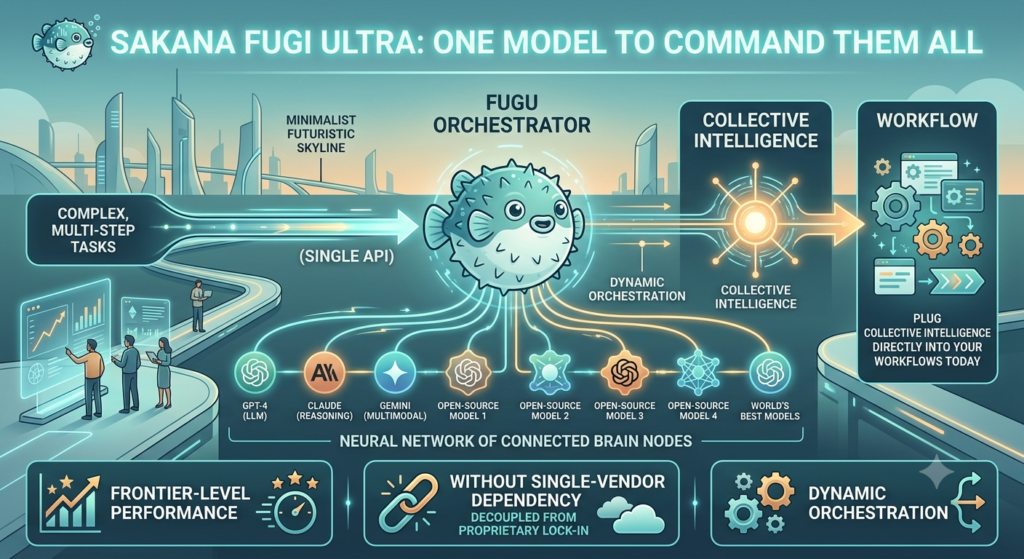
Fugu Ultra is not one single model. It is a smart coordinator that sits on top of multiple models.
Unlike traditional AI providers that focus on training a single, massive “brain,” Sakana AI’s Fugu (launched in June 2026) takes a fundamentally different approach to architecture and philosophy.
While Claude (Anthropic), Meta, and Google build massive, monolithic foundation models, Sakana Fugu is a multi-agent orchestration system that behaves like a single foundation model.
Here is exactly how Fugu sets itself apart from the tech giants:
1. The Architecture: Monolith vs. Conductor
- Google, Meta, & Anthropic: They train monolithic neural networks (like Gemini 3.1 Pro or Claude Fable 5) from scratch using thousands of GPUs. When you send a prompt, one single massive model processes your request and returns an answer.
- Sakana Fugu: Sakana did not train a massive foundation model to compete directly. Instead, they trained a smaller, highly specialized LLM to act as a smart project manager or “Conductor”. When you hit Fugu’s single, OpenAI-compatible API endpoint, Fugu evaluates the prompt, breaks it down, and coordinates a hidden, underlying pool of the world’s best models (including Claude, Gemini, and GPT instances) to do the heavy lifting.
2. Learned Orchestration vs. Hardcoded Agent Frameworks
You might wonder how this differs from traditional agent frameworks like LangGraph or CrewAI.
- In LangGraph or CrewAI, you (the developer) have to write hardcoded Python logic, code-level routing rules, and explicitly define what Agent A says to Agent B.
- In Fugu, the orchestration layer is baked right into the model itself via neural training (built on Sakana’s TRINITY and Conductor research). Fugu dynamically learns how to spin up a team, assign roles (like Thinker, Worker, and Verifier), and recursively self-correct its work in natural language before giving you a single, unified output.
3. Hedging Against Geopolitics and Vendor Lock-In
The driving philosophy behind Fugu is AI Sovereignty and resilience against single-vendor failure or strict export controls.
- If Anthropic or Google suffers a major API outage, or if geopolitical export bans cut off access to a specific top-tier frontier model, applications built directly on those providers break.
- Fugu features an entirely swappable agent pool. If one underlying model or provider blocks access or goes offline, Fugu seamlessly routes your task to a different model in the background without you needing to change a single line of code.
Quick Comparison Table
| Feature | The Big Three (Google, Meta, Anthropic) | Sakana Fugu / Fugu Ultra |
| Core Nature | Monolithic foundation model providers. | LLM-powered multi-agent orchestrator. |
| Under the Hood | Proprietary internal weights trained from scratch. | A smart router combining collective intelligence from multiple external APIs. |
| Best Suited For | Fast, single-turn responses, conversational depth, and raw foundational logic. | Long, complex, multi-step tasks (e.g., autonomous research, intense code gen, deep patent/security audits). |
| Resilience | Single point of failure (vendor lock-in). | Fault-tolerant; dynamically routes around provider outages or export restrictions. |
| Visibility | You know exactly which model version answered your prompt. | Proprietary routing; you don’t see which underlying backend model handled which sub-task. |
The Trade-Offs to Keep in Mind
While Fugu Ultra matches or beats top-tier frontier models on massive engineering and scientific benchmarks (like GPQA-Diamond) by leveraging the “wisdom of the crowd,” it comes with a cost. Because it orchestrates multiple calls, reviews work, and loops recursively, it is significantly slower and operates with higher latency than hitting a single model like Gemini or Claude directly. It is designed for deep, autonomous execution rather than snappy, interactive chat.
What Does “Plug Collective Intelligence Into Your Workflows With a Single API” Mean?
Let’s decode Sakana’s key marketing line piece by piece:
| Phrase | Simple Translation |
|---|---|
| “Collective intelligence” | The combined brainpower of multiple AI models working together, not just one |
| “Plug directly into your workflows” | You don’t need to rebuild your app or learn new tools — it fits into what you already use |
| “With a single API” | You make one call to Fugu Ultra, and it handles talking to all the other models behind the scenes |
The “So What?” for Developers and Businesses
Imagine you are building an app that needs AI to:
- Write code → GPT-5.5 is great at this
- Debug that code → Claude Opus 4.8 is better at reasoning
- Explain the code to a non-technical user → Gemini 3.1 Pro excels at clear explanations
Without Fugu Ultra, you would need to:
- Sign up for 3 separate APIs
- Pay 3 separate bills
- Write code to switch between them manually
- Figure out which one to use for each task
With Fugu Ultra, you:
- Make one API call
- Fugu Ultra automatically coordinates multiple specialized AI agents to handle different parts of your task. While Sakana AI has indicated this includes a diverse pool of frontier models, the exact scope of external model integration versus internal agent variants is still emerging
- You get one unified answer back
That’s the “single API” promise. You get the collective strength of many models, but the simplicity of using just one.
Quick Analogy: The Smartphone Camera
Think of your smartphone camera app:
- It doesn’t make the camera sensor, the image processor, or the AI that enhances photos.
- It orchestrates them: detects faces, adjusts lighting, applies filters, and gives you one great photo.
- You just press one button.
Fugu Ultra is the “camera app” for AI models. You ask one question, it orchestrates the best “sensors” (models), and delivers one great answer.
How Does It Work? The Science Behind the Coordination
What makes Fugu Ultra genuinely fascinating is that its coordination strategy isn’t hardcoded by human engineers. Instead, it is built on Sakana AI’s proprietary research into multi-agent task decomposition and reinforcement learning-based coordination strategies.
In other words, Fugu Ultra learns how to best delegate and collaborate—adapting its orchestration strategy based on the task at hand. This is a significant departure from traditional “router” models that simply send queries to the cheapest or fastest backend.
The Benchmarks: Competitive, But Context Matters
Sakana AI claims that Fugu Ultra matches or exceeds the performance of top-tier models on several rigorous benchmarks:
| Benchmark | Fugu Ultra Score | Comparison |
|---|---|---|
| SWE-Bench Pro | 73.7 | Matches Claude Opus 4.8 |
| LiveCodeBench | 93.2 | Exceeds GPT-5.5 |
| GPQA-D | 95.5 | Competitive with Gemini 3.1 Pro |
These numbers are impressive, but it’s important to note a critical caveat: these are self-reported benchmarks by Sakana AI. Independent third-party verification is still emerging, and as with any new AI release, real-world performance may vary from controlled testing environments.
Why This Matters: AI Sovereignty and Vendor Independence
Beyond the technical architecture, Fugu Ultra arrives at a strategically significant moment.
With increasing export controls and licensing restrictions on frontier models (such as recent limitations on Anthropic’s Claude in certain regions), organizations are facing a growing risk: vendor lock-in. If your entire AI stack depends on a single provider, a policy change or service discontinuation can be catastrophic.
Sakana AI explicitly positions Fugu Ultra as a hedge against this dependency. By orchestrating across multiple models and providers, it offers a layer of resilience. If one backend becomes unavailable or restricted, the system can theoretically reroute to alternatives.
This isn’t just a technical feature—it’s a business continuity strategy.
Accessibility and Pricing
Unlike many frontier systems that are locked behind enterprise contracts, Fugu Ultra is accessible:
- Standard Tier: $20/month — includes both Fugu and Fugu Ultra.
- Enterprise Tier: $50/month per user — with advanced features like custom agent pools and audit logs.
This pricing makes it approachable for individual developers, startups, and small teams who want to experiment with top-tier AI capabilities without massive upfront costs.
However, there are limitations:
- No free tier is currently available.
- EU/EEA access is pending due to GDPR compliance requirements.
- Fugu Ultra uses a fixed agent pool — unlike the standard Fugu tier, you cannot opt out specific providers.
The Real Question: Is This the Future?
Fugu Ultra forces us to ask a deeper question: Is the future of AI a single, ever-larger model, or a federation of specialized models working in concert?
The “bigger is better” approach has driven remarkable progress, but it also comes with immense computational costs, environmental impact, and centralization risks. The orchestration paradigm—if it can deliver consistent, verifiable results—offers a compelling alternative:
- Specialization over generalization: Different models excel at different tasks. Why force one model to do everything?
- Resilience over dependence: A distributed system is inherently more robust.
- Efficiency over scale: Smaller, specialized models may be cheaper and faster to run.
Of course, the orchestration approach introduces its own complexities: latency, coordination failures, and the challenge of debugging a “black box” system that delegates to other “black boxes.”
Bottom Line
Traditional models = one expert.
Fugu Ultra = a smart team of experts managed by one coordinator.
“Single API” = you talk to the coordinator, not each expert individually.
Sakana Fugu Ultra is one of the most interesting AI releases of 2026—not because it claims to be the “best” model, but because it challenges the definition of what a model is. It represents a shift from model competition to system architecture innovation.
For developers, enterprises, and AI enthusiasts, it’s worth watching closely. But as with any new technology, the hype should be tempered with healthy skepticism until independent benchmarks and real-world use cases validate the claims.
The future of AI might not be a single giant. It might be a well-orchestrated orchestra.
What do you think? Is multi-agent orchestration the next evolution of AI, or will single massive models continue to dominate? Share your thoughts below or ask our AI for a deeper technical breakdown.