The 1980s AI Photo Trend, Explained — From Pixels to Period-Correct Bollywood Glamour
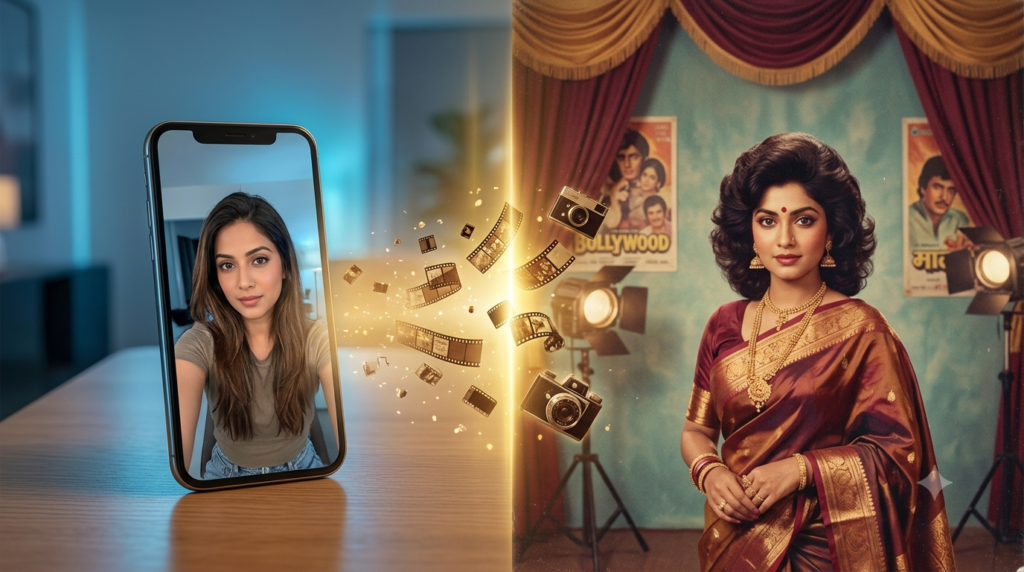
Scroll through Instagram or X in India right now and you’ll see something strange: your friends, your favourite politicians, and half your family appearing in photographs that look like they were pulled from a dusty family album circa 1985. Big teased hair. Silk sarees. High-waisted trousers tucked into belts that have no business being that high. Warm, faded, grainy colours that scream “old studio portrait.”
Except these people weren’t born yet — or were toddlers — in 1985. These images are AI-generated, and almost all of them come from one place: ChatGPT.
This isn’t just another viral filter. It’s a live demonstration of how far image-generation AI has come, and it involves some genuinely interesting technical machinery under the hood. Let’s break it all down: the model doing the work, how it “understands” a simple prompt, how it keeps your face recognisably yours, and the prompt-engineering logic that separates a convincing vintage portrait from a cheap filter.
1. What Exactly Is This Trend?
The trend is deceptively simple. A user uploads a modern selfie or portrait to ChatGPT, types a prompt (or pastes one copied from a viral post), and seconds later receives a photorealistic image that looks like it was shot in 1980s India — but with the user’s face, skin tone, and identity fully preserved.
The transformations go far beyond colour grading. The AI rebuilds:
- Hair — voluminous, teased, period-accurate styles
- Clothing — silk sarees, kasavu sarees for Kerala looks, tucked-in shirts, high-waisted trousers, moustaches
- Accessories — gold jewellery, oversized glasses, chunky watches
- Background & pose — studio backdrops, home interiors, family-album settings
- Lighting & texture — warm tungsten/studio light, soft focus, 35mm analogue film grain, slightly faded colours
The results evoke Bollywood publicity stills, old wedding portraits, magazine covers, and South Indian cinema icons. The trend exploded across India in early-to-mid September 2026, drawing in politicians, celebrities, and millions of everyday users, with regional variants (Tamil cinema looks, Kerala kasavu styles) spreading rapidly in the South.
Notably, this isn’t Instagram’s “Amaro” filter cranked up. A filter adjusts the colour and texture of existing pixels. This AI rebuilds the entire scene around your face. That’s a fundamentally different — and much harder — technical problem.
2. The Model Behind the Magic
The engine behind this wave is ChatGPT Images 2.5, OpenAI’s latest native image-generation model, released around 8 September 2026 — almost exactly when the trend peaked. Timing, as we’ll see, was everything.
Why this model, and not the older pipeline?
To appreciate what’s new, it helps to understand what came before. The original DALL·E 3, which powered ChatGPT’s image generation for years, was largely a separate text-to-image system bolted onto the chat experience. It was good, but it had persistent weaknesses:
- Identity drift — asking it to edit an image often changed the person’s face
- Weak instruction-following on complex, multi-part prompts
- Slow generation, making iteration painful
- Limited ability to reason about photographs as photographs (lighting physics, film stock characteristics, etc.)
ChatGPT Images 2.5 belongs to a different lineage — it’s a natively multimodal model, a successor to the GPT-Image / GPT-4o family of image models. The key architectural difference: it doesn’t just call a separate image model with a text caption. It processes your uploaded photo and your text prompt in a unified representation space, then generates new image tokens in a manner analogous to how an LLM predicts the next word — except here, it’s predicting the next visual “patch” of the image.
The capabilities that made this trend possible
Table
| Capability | Why it matters for 1980s photos |
|---|---|
| Strong identity preservation | Your face survives a complete wardrobe, hairstyle, and background overhaul |
| Multi-turn conversational editing | “Keep the face, change only the hair” — without the face drifting |
| Photographic reasoning | Understands film grain, studio lighting falloff, colour fading of 1980s print stock |
| Faster generation (~50% lower latency vs. Images 2.0) | Seconds per image makes mass participation feasible |
| Two variants (Flare / Sunburst) | Speed vs. precision trade-off — Sunburst for detail-heavy portraits |
That last point about photographic reasoning deserves emphasis. The model has internalised, from training data, what a 1980s Indian studio portrait actually looks like — the lighting falloff, the colour response of old film stock, the slightly soft focus of period lenses. When your prompt mentions these traits, the model isn’t guessing; it’s drawing on learned representations of real photographic conventions. That’s why results feel like “genuine old photos” rather than modern photos with a sepia overlay.
The honest caveat: ChatGPT isn’t the only game in town
Google’s Gemini (Nano Banana family) has been particularly strong at identity consistency and multi-reference blending. Microsoft Copilot (often running OpenAI tech under the hood), Grok, Kimi, and Midjourney can all perform similar transformations. The effect itself isn’t unique to ChatGPT. What made this particular wave explode in India was ChatGPT’s combination of model quality, conversational editing, a massive existing Indian user base, and perfectly timed cultural virality. More on that in Section 6.
3. The Core Technical Trick: Identity-Preserving Scene Reconstruction
So how does the model keep your face recognisable while changing literally everything else? This is the heart of the trend, and it comes down to three mechanisms working together.
3.1 Unified multimodal conditioning
When you upload a photo, it isn’t compressed into a text description like “a woman with dark hair smiling.” The model encodes the image into rich visual representations — capturing facial geometry, skin tone, lighting on the face, expression, and dozens of subtler attributes. Your prompt is encoded in the same shared space. Generation is then conditioned on both simultaneously.
Think of it as the model holding two things in mind at once: “this specific face” (from pixels) and “1980s Bollywood heroine, silk saree, studio lighting” (from text). Every image patch it generates is influenced by both. The face regions are anchored strongly to the uploaded photo; the hair, clothing, and background regions are anchored more strongly to the text instruction.
3.2 Attention-based facial anchoring
Modern image transformers use attention mechanisms that let every part of the generated image “look at” the reference photo during creation. Facial features — the geometry of the jawline, the distance between eyes, skin tone, distinctive marks — act as high-priority anchors. The model effectively allocates more “consistency pressure” to identity-critical regions than to style-critical regions.
This is also why vague prompts fail: if the model isn’t told which aspects of the face are non-negotiable, it may treat your features as just another style element to be reimagined.
3.3 Iterative refinement without drift
Earlier models suffered from a nasty failure mode: ask for one small edit (“change the saree colour”) and the whole face would subtly change too. Images 2.5’s conversational editing works differently — it treats the original image as a persistent reference throughout the dialogue, so localised instructions produce localised changes. This is what makes the “iterate until it’s perfect” workflow viable, and it’s a big part of why users trust the outputs enough to share them.
4. “Convert This Photo as 1980s” — What ChatGPT Actually Does With a Simple Prompt
Here’s the fascinating part: even when a user types a lazy, two-word prompt, the model still produces something decent. Why?
Prompt understanding ≠ keyword matching
The model doesn’t parse “1980s” as a lookup in a style database. Through training on enormous corpora of images and their captions, discussions, and metadata, it has learned a dense conceptual representation of “the 1980s” — fashion silhouettes, hairstyles, colour palettes, photographic equipment of the era, cultural aesthetics, even regional variations (it can distinguish 1980s Tamil cinema from 1980s Kerala family portraits).
So a simple prompt activates this entire learned cluster. The model fills in the gaps with the most probable 1980s interpretation: it assumes period-appropriate styling, analogue photographic characteristics, and era-consistent backgrounds.
But here’s the catch: default ≠ authentic
The model’s “default 1980s” is a statistical average. It tends to produce:
- Styling that reads as “costume-y” rather than period-authentic
- Film-grain effects that look digitally simulated rather than organic
- Lighting that feels modern-flat rather than warm-tungsten
- Backgrounds that are generically “old-looking” rather than genuinely Indian 1980s
In other words, a simple prompt gets you a modern photo wearing a vintage disguise. The face preservation still works (that’s anchored by the photo, not the prompt), but everything else feels like a filter — which is exactly why people who use detailed prompts get dramatically better results.
5. Prompt Engineering: The Logic Behind Great 1980s Portraits
This is where the real craft lives. The difference between a mediocre output and a stunning one is almost entirely in prompt specificity. Here’s the underlying logic, and how to apply it.
The five-layer prompt architecture
Every effective prompt for this trend combines five layers. Missing any of them produces a predictable weakness:
Layer 1 — Identity lock (the anchor)
“Keep the person’s facial features, face shape, skin tone, identity, and expression unchanged. Do not alter facial structure.”
Why it matters: Without explicit identity instructions, the model balances face fidelity against style transformation, and the face drifts. Explicitly marking identity as non-negotiable sharpens the attention anchoring described in Section 3.
Layer 2 — Scene directive (the transformation)
“Transform this photo into an authentic 1980s South Indian cinema portrait.”
Why it matters: One strong, specific scene concept beats five vague ones. “Authentic” and a specific cultural context (Bollywood / Tamil cinema / Kerala family album) activate the model’s region-specific learned representations instead of a generic Western 80s aesthetic.
Layer 3 — Period styling (the specifics)
“Voluminous teased hair with soft curls, deep maroon silk saree with gold zari border, traditional gold temple jewellery, subtle bindi.”
Why it matters: Specificity constrains the model’s imagination toward realism. Generic prompts let it default to costume-movie stereotypes; specific prompts pull from the model’s learned knowledge of real period fashion photography.
Layer 4 — Photographic physics (the authenticity)
“Warm vintage studio lighting with soft falloff, subtle 35mm analogue film grain, slightly faded but realistic colours, gentle soft focus, natural skin texture with imperfections.”
Why it matters: This is the layer that separates “AI image” from “old photograph.” Each term maps to a real photographic phenomenon the model has learned: lighting falloff, grain structure, colour fading, optical softness. You’re not asking for “a vintage look” — you’re specifying the physical mechanisms that produce the vintage look.
Layer 5 — Negative constraints (the guardrails)
“Make it look like a genuine photograph taken in India in the 1980s — not a modern photo with a vintage filter. No modern objects, no smartphones, no contemporary fashion elements.”
Why it matters: Negative constraints are surprisingly powerful. “Not a modern photo with a vintage filter” explicitly steers the model away from its default failure mode (surface-level colour grading).
A complete template prompt
“Recreate this uploaded photo as an authentic 1980s Indian studio portrait. Keep my facial features, face shape, skin tone, identity, and expression exactly the same — do not alter my facial structure. Style me with voluminous 1980s hair, a silk saree with gold border, and traditional gold jewellery. Use warm vintage studio lighting, soft focus, realistic 35mm film grain, and slightly faded colours. It should look like a genuine photograph taken in India in the 1980s, not a modern photo with a filter. No modern objects.”
The iterative refinement loop
The best results rarely come from one prompt. The conversational workflow looks like this:
- Generate with the full five-layer prompt.
- Diagnose the specific weakness — too much face drift? Hair too modern? Colours too saturated? Grain too digital?
- Issue a surgical follow-up — “Keep the face exactly the same, only soften the lighting.” or “The saree looks too modern — make it a 1980s Kanjeevaram style.”
- Repeat until satisfied.
This works because of the model’s multi-turn identity anchoring — follow-up edits are localised, so refinements compound instead of resetting the image.
6. Why It Went Viral Now — and in ChatGPT
Four forces converged in September 2026:
- The model-quality leap. Images 2.5 shipped days before the peak, with face preservation and photographic realism good enough to survive mass scrutiny. Earlier tools could approximate this; they couldn’t do it consistently.
- Accessibility. ChatGPT has a huge user base in India. Upload → paste prompt → result in seconds → iterate in plain language. No Discord, no parameters, no separate app.
- Cultural resonance. 1980s Bollywood and South Indian cinema, family albums, and studio portraits carry deep nostalgia. The prompts localise effortlessly — kasavu sarees, mundus, Rajinikanth-era styling — making it feel personal, not just trendy.
- Social mechanics. Instagram “Add Yours” stickers, Reels, X memes, and political versions (politicians joining in gave it news-cycle legitimacy). Audiences were already primed by earlier AI photo fads like the Ghibli-style wave.
The timing wasn’t an accident of culture meeting technology — it was technology enabling culture at exactly the right moment.
7. Limitations and the Fine Print
Worth including in any honest discussion:
- Face drift still happens, especially on complex edits or when the reference photo is low-quality or at an odd angle.
- Anatomy quirks — hands, jewellery details, fabric folds occasionally render incorrectly.
- Safety filters may refuse certain edits.
- Compute cost — high-quality image generation is energy-intensive at scale.
- Privacy — uploading your face shares biometric-level data with a cloud provider. The outputs are fun; the data implications deserve a moment’s thought.
8. The Bigger Picture
This trend is a milestone, not a novelty. It demonstrates that modern image models have crossed a threshold: they no longer just “apply a style” — they perform identity-preserving scene reconstruction guided by natural language. The model understands what a photograph is, what an era looked like, and what you look like, and weaves all three into a single coherent output.
The prompt engineering matters more than the model alone — but the model is finally good enough that the prompt engineering pays off. That combination is what turned a technical capability into a cultural moment.
Next time you see a “1980s me” photo on your feed, you’ll know: it’s not a filter, it’s not magic — it’s a multimodal transformer, a well-structured prompt, and a model that finally learned to keep your face while changing your world.