System Blueprints #001 | Published: September 3, 2026
1. The Problem
Netflix’s recommendation engine was already world-class at answering: “What will this user watch next?” But that question only optimizes for correlation — it predicts behavior based on past behavior. It cannot answer the far more valuable business question: “What would this user watch if we changed something?”
This is the difference between prediction and causal inference. If Netflix changes a thumbnail, moves a title to the top row, or introduces a new category, the standard recommendation model has no mechanism to estimate the counterfactual — what would have happened if they had not made that change.
By early 2025, Netflix’s product teams were hitting a ceiling. A/B tests were becoming combinatorially expensive. You cannot run 10,000 concurrent experiments for every thumbnail × title × user segment combination. They needed an architecture that could estimate causal effects proactively, at inference time, without actually running the intervention.
The solution was an agentic causal inference layer — a system that treats causal reasoning as a first-class inference problem, not an offline analytics exercise.
2. The Constraints
Building this at Netflix scale meant operating under brutal, non-negotiable limits:
| Constraint | Specification | Why It Hurts |
|---|---|---|
| Latency | <50ms for the full recommendation response | Causal models are inherently more expensive than correlational ones |
| Scale | 260M users, 450B+ events/day | Every millisecond of overhead multiplies across billions of requests |
| Combinatorial Explosion | 15K+ titles × dozens of artwork variants × hundreds of user contexts | You cannot pre-compute or A/B test every permutation |
| Accuracy vs. Speed | Causal estimates must be “directionally correct” for ranking, not perfect for science | Product decisions need confidence intervals, not p-values |
| Cold Start | New titles have no causal history | The system must generalize from sparse signals |
The core architectural challenge: How do you run causal reasoning without running causal reasoning on every request?
3. The Architecture
Netflix’s solution is a three-tier inference router that separates “questions we already know the answer to” from “questions that actually need computation.”
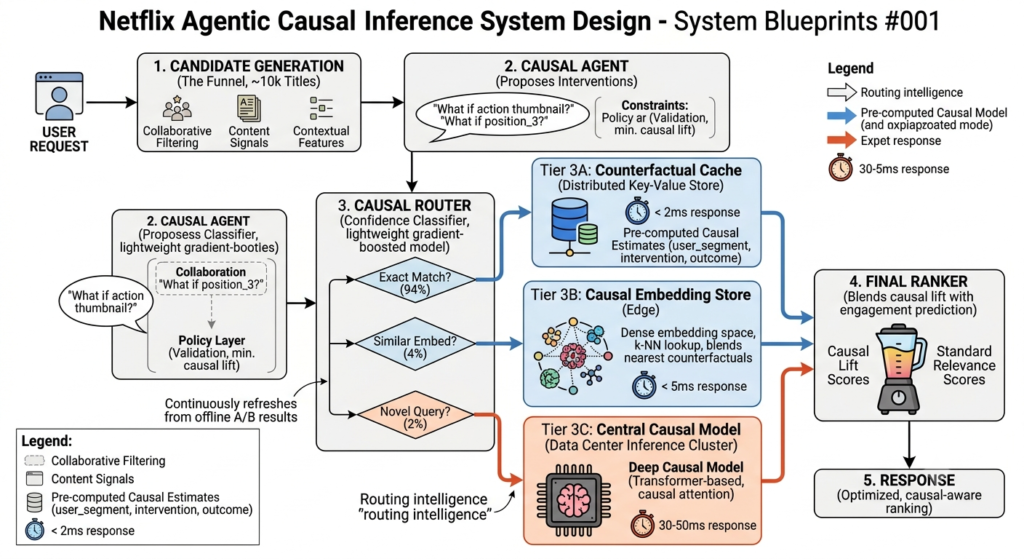
High-Level Flow
User Request → Candidate Generation → Causal Router → [Edge Cache OR Central Model] → Ranker → ResponseComponent Breakdown
Tier 1: Candidate Generation (The Funnel)
This is Netflix’s existing battle-tested pipeline. Collaborative filtering, content-based signals, and contextual features generate ~10,000 candidate titles per user session. This stage is unchanged — causal inference only enters at the ranking layer.
Tier 2: The Causal Router
The router is the architectural innovation. For every (user, title, intervention) triplet, it checks:
- Have we seen this causal query before? → Serve from Counterfactual Cache
- Is this a “near neighbor” of a cached query? → Interpolate from Causal Embedding Store
- Is this genuinely novel? → Route to Central Causal Model
The router itself is a lightweight classifier (a small gradient-boosted model) trained to predict confidence — not the causal effect itself, but the confidence that the cache or embedding store can answer accurately.
Tier 3A: Counterfactual Cache (Edge)
A distributed key-value store holding pre-computed causal estimates. These are computed offline via Netflix’s causal inference platform (historically built on frameworks similar to their internal CausalLens infrastructure) and refreshed continuously as new A/B tests conclude.
- Hit rate target: ~94% of causal queries
- Latency: <2ms
- Storage: Billions of (user_segment, intervention, outcome) tuples
Tier 3B: Causal Embedding Store (Edge)
For queries not in the exact-match cache, a dense embedding space allows approximate retrieval. Similar user segments and similar interventions cluster together. A k-NN lookup retrieves the nearest cached counterfactuals and blends them.
- Hit rate target: ~4% of remaining queries
- Latency: <5ms
Tier 3C: Central Causal Model (Data Center)
The “heavy artillery.” A deep causal model (typically a transformer-based architecture with causal attention mechanisms) that estimates treatment effects from raw features. This runs in Netflix’s central inference cluster, not at the edge.
- Hit rate target: ~2% of queries (the true long tail)
- Latency: 30-50ms (acceptable because it’s rare)
The Agentic Layer
Here’s where “agentic” enters. The system doesn’t just passively rank — it actively proposes interventions. A lightweight agent monitors the user’s current session context and generates a small set of “what-if” candidates:
- “What if we show the action thumbnail instead of the rom-com thumbnail?”
- “What if we surface this title 3 rows higher?”
These proposals are fed into the causal router. The agent is constrained by a policy layer — it can only propose interventions that are (a) within the current candidate set, and (b) have a minimum predicted causal lift.
Data Flow Diagram
┌─────────────────────────────────────────────────────────────────┐
│                         USER REQUEST                             │
└──────────────────────┬──────────────────────────────────────────┘
                       │
                       ▼
┌─────────────────────────────────────────────────────────────────┐
│  CANDIDATE GENERATION (10K titles)                               │
│  • Collaborative filtering                                       │
│  • Content signals                                               │
│  • Context features                                              │
└──────────────────────┬──────────────────────────────────────────┘
                       │
                       ▼
┌─────────────────────────────────────────────────────────────────┐
│  CAUSAL AGENT (Proposes interventions)                           │
│  • "What if thumbnail_A?"                                        │
│  • "What if position_3?"                                         │
└──────────────────────┬──────────────────────────────────────────┘
                       │
                       ▼
┌─────────────────────────────────────────────────────────────────┐
│  CAUSAL ROUTER (Confidence classifier)                           │
│  ┌─────────────┐  ┌─────────────────┐  ┌─────────────────────┐ │
│  │ Exact Match?│→ │ Counterfactual  │→ │   < 2ms response    │ │
│  │  (94%)      │  │    Cache        │  │                     │ │
│  └─────────────┘  └─────────────────┘  └─────────────────────┘ │
│         └────────────────────────────────────────┐              │
│                  ┌─────────────────┐  ┌──────────▼──────────┐  │
│                  │ Similar Embed?  │→ │ Causal Embedding    │  │
│                  │    (4%)         │  │    Store            │  │
│                  └─────────────────┘  │   < 5ms response    │  │
│                                       └─────────────────────┘  │
│                  ┌─────────────────┐  ┌─────────────────────┐  │
│                  │  Novel Query?   │→ │  Central Causal     │  │
│                  │    (2%)         │  │     Model           │  │
│                  └─────────────────┘  │  30-50ms response   │  │
│                                       └─────────────────────┘  │
└──────────────────────┬──────────────────────────────────────────┘
                       │
                       ▼
┌─────────────────────────────────────────────────────────────────┐
│  FINAL RANKER (Blends causal lift with engagement prediction)    │
└──────────────────────┬──────────────────────────────────────────┘
                       │
                       ▼
┌─────────────────────────────────────────────────────────────────┐
│                         RESPONSE                                 │
└─────────────────────────────────────────────────────────────────┘
4. The Trade-offs
No architecture is free. Netflix made three explicit, painful trade-offs:
Trade-off 1: Accuracy for Latency
The counterfactual cache serves 94% of queries, but cached estimates are stale by definition. A thumbnail’s true causal effect drifts as user preferences shift. Netflix accepts this because:
- Directional correctness (ranking A > B) degrades slower than magnitude accuracy
- The cache refreshes continuously from new A/B test outcomes
- The 2% of queries that hit the central model act as a “drift detector”
Trade-off 2: System Complexity
They replaced a single recommendation ranker with a two-model + router + cache architecture. Operational overhead increased significantly:
- Cache invalidation logic is now business-critical
- The router must be retrained as user behavior shifts
- Debugging a bad recommendation requires tracing through three tiers instead of one
Trade-off 3: Storage Cost
Billions of counterfactual tuples require substantial distributed storage. But Netflix’s math is simple: storage is cheaper than inference. A cached lookup costs fractions of a cent; a central model inference costs 100x more. At 450B events/day, that trade-off pays for itself.
5. The Lesson
For Indian AI engineers building today: You don’t need causal inference everywhere. You need a router pattern that separates “easy” predictions from “hard” ones.
Most teams make the mistake of running their most expensive model on every request. Netflix’s architecture proves that intelligent routing is often more impactful than model improvement.
Here’s how to apply this pattern to your next project:
- Start with a cache. Pre-compute your expensive inferences offline. Even a simple Redis cache with TTL can eliminate 80% of your inference load.
- Build a confidence classifier. Don’t route by heuristics — train a small model to predict whether your cache can answer accurately. This is often a logistic regression or a small XGBoost model.
- Reserve heavy models for the long tail. Your central model should handle <5% of requests. If it’s handling more, your cache or embedding store is underperforming.
- Accept “good enough” for the majority. Perfect is the enemy of shipped. A 94% cache hit rate with 90% accuracy beats a 0% hit rate with 99% accuracy.
Further Reading
- Netflix Technology Blog: Causal Inference at Netflix
- “CausalLens: A Causal Inference Platform” — Netflix internal architecture patterns
- System Design Handbook: AI System Design
About System Blueprints
System Blueprints is a weekly deep-dive into real-world AI architectures running at massive scale. Every Wednesday, we dissect one production system — the constraints, the trade-offs, and the one lesson you can apply today. Suggest the next blueprint [here].