Why DeepSeek’s new “dsh” framework hit 95,000 GitHub stars in two days — and what it means for the future of AI agents.
If you’ve been anywhere near AI Twitter, Reddit, or a developer community in the last week, you’ve heard about DeepSeek Harness. Released by DeepSeek AI on August 13, 2026, the open-source agent framework crossed 95,000 GitHub stars and 8,800 forks within roughly two days of publication — one of the fastest adoption curves GitHub has ever recorded for a developer tool . Some community members are even calling the launch more interesting than the DeepSeek V4-Pro model it shipped alongside.
So what exactly is it, why is everyone talking about it, and should you care? Let’s break it down.
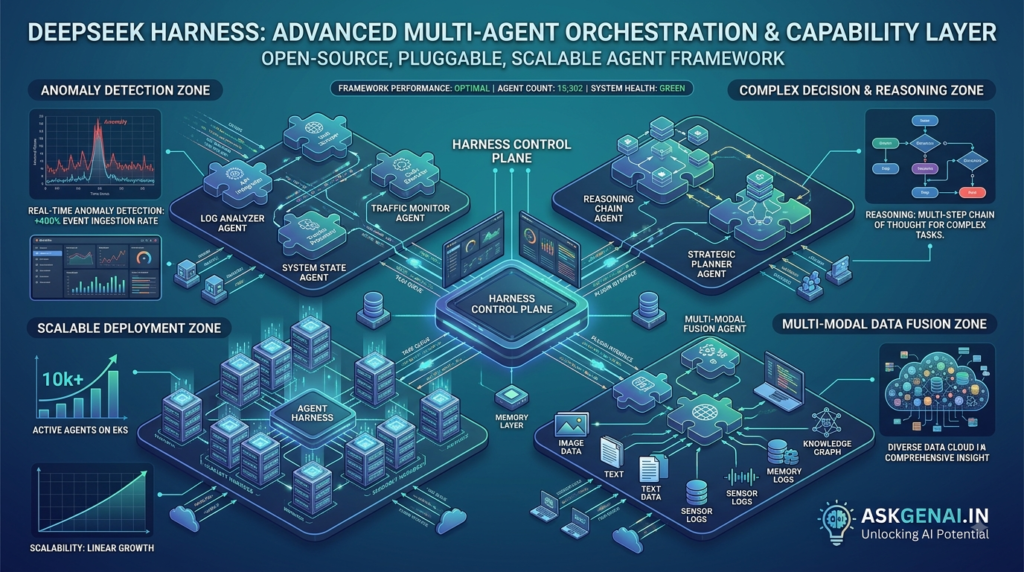
What Is DeepSeek Harness?
DeepSeek Harness (command-line name: dsh) is an open-source, MIT-licensed agent harness — the layer of software that connects a large language model to the real world: file systems, shell commands, tool calls, sessions, approvals, and long-running workflows .
DeepSeek frames the idea with a simple equation:
Agent = Model + Harness
Tools like Anthropic’s Claude Code and OpenAI’s Codex package this harness layer as commercial products with limited extension points. DeepSeek Harness takes the opposite position — one radical idea stated in the very first lines of its README:
Everything is a plugin.
Models, tools, skills, sessions, sandboxes, storage, the agent loop itself, scheduling, and even the UI are all implemented as plugins, and every single one can be selected, swapped, or extended in configuration without changing the source code.
Getting started takes one command:
bash
npx @deepseek-ai/dsh webThis spins up a local browser UI on http://127.0.0.1:3080.
The Secret Sauce: Cordis
The plugin architecture isn’t just a folder of hooks — it’s built on Cordis, an open-source meta-framework described in DeepSeek’s accompanying paper, “A Programming Paradigm for Spatiotemporal Composability”.
Cordis formalises two ideas:
- Spatial composability — components can declare and manage dependencies on each other.
- Temporal composability — every change a plugin makes is a revertible effect: remove the plugin and its effects are cleanly undone, at runtime, without restarting the application .
If you’ve ever used VS Code, you know its extensions can’t be unloaded without restarting the editor. Cordis was designed specifically to solve that class of problem — and it’s what makes an “everything-is-a-plugin” agent runtime tractable instead of chaotic .
Why It’s Different from Claude Code and Codex
The key distinction is provider-agnostic composability:
- Swap the model. Because the model adapter is just another plugin, Harness works with DeepSeek, Anthropic, OpenAI, Amazon Bedrock, Google Vertex, Azure, or any OpenAI-compatible endpoint — including local models via Ollama .
- Swap the agents. Harness can even call Claude Code or Codex as sub-agents inside a DeepSeek-orchestrated workflow, making it less a competitor and more a framework that can sit above them .
- Four operating modes — Standard, Code, Minimal, and Creator — each loading a different default plugin set .
- Auditable everything. An append-only session log captures every context injection; resume, fork, search, and replay all share one event stream — a big deal for regulated industries .
Even Armin Ronacher (of Flask fame, now steering the Pi agent) weighed in: “I don’t think the DeepSeek Harness is perfect but this is for sure the first time I have been looking at something new in the space and felt quite inspired to revisit some of our choices”.
The Benchmarks and the Fine Print
DeepSeek reports that V4-Pro-0813, tested using the Harness in minimal mode, scores:
Table
| Benchmark | Score |
|---|---|
| Terminal Bench 2.1 | 87.9 |
| Toolathlon-Verified | 74.1 |
| DSBench-FullStack | 71.1 |
Real-world testers report genuinely impressive output — one built a real-time International Space Station tracker with an accurately rendered Earth shader — but also flag heavy token consumption: that test burned through roughly 20 million tokens over two turns and ~35 minutes, though cache hit rates of 95–100% helped offset the cost .
The Timing: Peak/Off-Peak Pricing
The launch came alongside a significant pricing shift. From August 16, 2026, DeepSeek moved its V4 API family from flat pricing to peak/off-peak rates. V4-Flash cache-miss input runs at US$0.14 per million tokens, and V4-Pro at US$0.435 — already a 75% cut from April launch prices — but peak-window cache hits jumped as much as 12x . For teams in India (and Asia-Pacific broadly), peak windows largely overlap with business hours, so an agent harness that preserves prompt cache — as dsh does — directly translates into cost savings.
Should You Adopt It?
Yes, if: you’re an agent builder, a platform/dev-tools team, or anyone who wants open, inspectable, fully customisable agent infrastructure that can be re-pointed at any model as prices shift .
Wait, if: you need production stability today. This is explicitly a developer preview — the README warns in capital letters that “THERE WILL BE COMPATIBILITY-BREAKING CHANGES.” Notably, the public repo hasn’t received a commit since launch day, GitHub Issues are disabled (Discussions and Discord only), and there are no releases or tags — so pin your npm version (npx @deepseek-ai/dsh@0.1.0-rc.6) if you experiment .
The Bigger Picture
DeepSeek Harness signals something larger than one repository: Chinese AI labs are now competing beyond model benchmarks and pricing, moving up the stack into the tooling layer where developer loyalty is actually built . As models commoditise, the harness — the user interface, the workflows, the accumulated configuration — is where the lock-in lives. DeepSeek just made that layer free, open, and fully composable.
Whether or not dsh itself becomes the standard, the pattern it legitimises — fully composable agent runtimes with auditable logs and swappable everything — is very likely the direction every serious team’s agent estate moves toward .
Quick FAQ
Is DeepSeek Harness free? Yes — MIT licensed. You only pay for model API usage, and you can point it at free local models .
Can it use Claude or GPT models? Yes — the model adapter is a plugin, and Anthropic, OpenAI, Bedrock, Vertex, Azure, and OpenAI-compatible endpoints are supported .
Is it production-ready? No — it’s a v0.1 developer preview with explicit breaking-change warnings. Great for evaluation and prototyping; revisit for production later .
How do I try it? Install Node.js, then run npx @deepseek-ai/dsh web and open http://127.0.0.1:3080.