Open source freedom or managed polish? The decision that shapes your AI engineering workflow — and your monthly bill.
The Dilemma Every AI Team Faces
You’ve built your first LLM-powered feature. It works. Users love it. Then someone asks:
“How do we know if it’s getting worse over time?”
You realize you need observability. You Google “LLM observability tools.” Two names dominate the results: Langfuse and LangSmith. Both trace your AI calls. Both show pretty dashboards. Both promise to debug your prompts.
But they’re fundamentally different animals. One is open-source, framework-agnostic, and MIT-licensed. The other is proprietary, LangChain-native, and polished to a shine. Choose wrong, and you’ll either fight your tooling for six months or pay 3x more than necessary at scale.
This article is the comparison we wish existed when we started. No vendor talking points. Just honest engineering trade-offs with real numbers.
What Are We Even Comparing? (For the Newcomers)
If you’re new to LLM observability, here’s the 30-second primer:
LLM observability is the practice of tracking, analyzing, and debugging AI model calls in production — not just “did it work?” but “why did it produce that output?” It includes:
- Tracing: Following a request through every step (user input → retrieval → LLM call → tool use → final output)
- Prompt Management: Versioning, testing, and deploying prompt templates
- Evaluation: Automatically scoring output quality before users see bad results
- Cost Tracking: Knowing exactly which feature, user, or conversation burned your API budget
Both Langfuse and LangSmith do all of this. The difference is how, for whom, and at what cost.
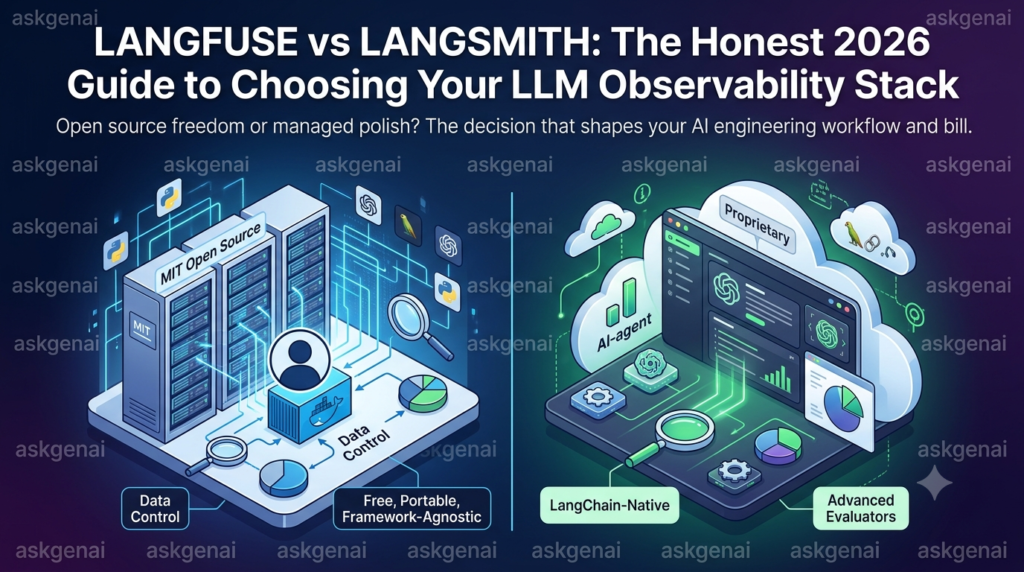
The Ownership Question: Open Source vs. Proprietary
This is the philosophical divide. Everything else flows from here.
Table
| Aspect | Langfuse | LangSmith |
|---|---|---|
| License | MIT Open Source | Proprietary Closed Source |
| Code Access | Full GitHub repo, read/modify/fork | None — black box |
| Self-Hosting | Free, full feature parity, 30-min Docker setup | Enterprise-only, custom pricing |
| Data Control | Your VPC, your S3, your ClickHouse | LangChain’s cloud (unless Enterprise) |
| Vendor Lock-in | Zero — OTel-native, portable | High — deepest value ties to LangChain |
Why This Matters in Practice
Scenario 1: Your compliance team reviews your architecture. They say: “LLM traces contain user PII, proprietary prompts, and competitive IP. They cannot leave our AWS account.”
- Langfuse:
docker compose upon your EC2 instance. Done. Data never leaves your VPC. No sales call required. - LangSmith: You need an Enterprise contract. Pricing is opaque. Implementation takes weeks, not minutes.
Scenario 2: You want to modify the tracing UI to show a custom metric your business cares about.
- Langfuse: Fork the repo, add your component, rebuild. The entire frontend is Next.js + TypeScript.
- LangSmith: You submit a feature request and wait.
Scenario 3: LangChain (the company behind LangSmith) gets acquired in 2027 and changes pricing or sunsets features.
- Langfuse: The MIT-licensed code is yours forever. Community forks maintain it.
- LangSmith: You’re along for the ride. Your data, your workflows, your prompts — all in a proprietary system you can’t migrate from easily.
New learners: Think of this like GitHub vs. a self-hosted GitLab. GitHub is polished and convenient. GitLab gives you the code. Both work. The question is who controls your destiny.
Framework Integrations: The Hidden Dealbreaker
This is where theory meets reality. You don’t use “LLM observability” in a vacuum — you use it with your specific stack.
Table
| Framework/Library | Langfuse | LangSmith |
|---|---|---|
| LangChain / LangGraph | ✅ Native integration | ✅ Native (best-in-class) |
| OpenAI SDK | ✅ Drop-in wrapper (langfuse.openai) | ⚠️ Manual @traceable decorator |
| Pydantic AI | ✅ Native integration | ❌ No integration |
| Vercel AI SDK | ✅ Native integration | ❌ No integration |
| LlamaIndex | ✅ Native callback handler | ⚠️ Basic via API |
| Anthropic SDK | ✅ Via @observe() decorator | ⚠️ Manual @traceable |
| CrewAI | ✅ Community integration | ⚠️ Via LangChain bridge |
| LiteLLM | ✅ Native | ⚠️ Via LangChain |
The 2026 Reality Check
Many teams in 2026 are building directly with OpenAI SDK, Pydantic AI, or Vercel AI SDK — not wrapping everything in LangChain abstractions. For these teams:
Langfuse has native integrations that “just work.” Change an import. Add a decorator. Traces appear.
LangSmith requires manual @traceable decorators on every function you want to trace. It works, but it’s friction. And if you use Pydantic AI or Vercel AI SDK? You’re out of luck — no integration exists.
The LangChain exception: If your entire stack is LangChain or LangGraph, LangSmith’s auto-tracing is genuinely magical. Every Runnable, every AgentExecutor, every RetrievalQA chain — traced automatically with zero code changes. This is LangSmith’s home turf, and it’s unbeatable here.
Verdict: Framework-agnostic teams → Langfuse. LangChain monogamists → LangSmith.
The Cost Math: Real Numbers at Scale
This is where the spreadsheet matters. Both have free tiers, but the cost curves diverge dramatically.
Pricing Structure
Table
| Tier | Langfuse | LangSmith |
|---|---|---|
| Free | 50K observations/month, 2 users | 5K traces/month, 1 seat |
| First Paid | Core: $29/month (100K units, unlimited seats) | Plus: $39/seat/month (10K base traces) |
| Overage | $8 per 100K units | Base traces: $2.50/1K (14-day retention) Extended traces: $5/1K (400-day retention) |
Real-World Scenario: 5 Engineers, 1 Million Traces/Month
Table
| Platform | Monthly Cost | What’s Included |
|---|---|---|
| Langfuse Core | ~$1,381 | Unlimited seats, 90-day retention |
| Langfuse Self-Hosted | ~$150–300 (infra only) | License $0, you run ops |
| LangSmith Plus (14-day retention) | ~$2,670 | 5 seats + overage |
| LangSmith Plus (400-day retention) | ~$5,145 | 5 seats + extended overage |
The Hidden Cost Trap
LangSmith’s pricing has two gotchas:
- Per-seat pricing compounds. At 5 engineers, you’re paying $195/month just for seats before sending a single trace.
- Retention tiers. The “base traces” included in your plan have 14-day retention. Need to debug something from last month? You need “extended traces” at 2x the price. Langfuse Core includes 90-day retention by default.
For a startup doing 1M traces/month: LangSmith costs 2–4x more than Langfuse Cloud, and 10–30x more than self-hosted Langfuse.
For an enterprise with 50 engineers and 10M traces/month: The gap widens further. Langfuse’s unlimited seats vs. LangSmith’s per-seat model becomes the deciding factor.
New learners: Don’t just look at the free tier. Project your 12-month growth. The tool that feels cheap today might bankrupt your AI budget tomorrow.
Feature Depth: Where Each Platform Shines
Tracing & Observability
Table
| Feature | Langfuse | LangSmith |
|---|---|---|
| Trace trees with spans | ✅ Deep, customizable | ✅ Deep, polished |
| Auto-tracing | Via @observe() decorator | Native for LangChain only |
| OpenTelemetry export | ✅ Native SDK architecture | ⚠️ Limited (ingest + export) |
| Custom metrics | ✅ Via OTel attributes | ⚠️ Via metadata fields |
| Session tracking | ✅ Multi-turn conversations | ✅ Multi-turn conversations |
Langfuse’s OpenTelemetry-native approach (v3, mid-2025) is architecturally significant. If your team already uses Jaeger, Grafana, or Datadog for distributed tracing, Langfuse traces appear in the same tools without duplicate instrumentation. LangSmith’s tracing format is proprietary — you can export some data to OTel backends, but the deepest value (Prompt Hub, native LangGraph tracing) binds you to their stack.
Prompt Management
Table
| Feature | Langfuse | LangSmith |
|---|---|---|
| Version control | ✅ Full history, diff view | ✅ Full history, diff view |
| Collaborative editing | ✅ Non-engineers can edit via UI | ✅ Non-engineers can edit via UI |
| Server-side caching | ✅ Zero latency penalty | ✅ Zero latency penalty |
| A/B testing | ✅ Deploy to user segments | ✅ Deploy to user segments |
| Rollback | ✅ Instant, no code deploy | ✅ Instant, no code deploy |
| Prompt Hub (community) | ❌ No | ✅ Share and discover prompts |
LangSmith’s Prompt Hub is a genuine differentiator. It’s a community repository of tested prompts for common tasks — summarization, extraction, classification. If you’re starting from scratch, this accelerates development. Langfuse has no equivalent community hub.
Evaluation & Testing
Table
| Feature | Langfuse | LangSmith |
|---|---|---|
| LLM-as-a-Judge | ✅ Custom evaluators | ✅ 30+ built-in templates |
| Code evaluators | ✅ Python/TypeScript | ✅ Python/TypeScript |
| User feedback | ✅ Thumbs up/down | ✅ Thumbs up/down |
| Manual labeling | ✅ UI for human reviewers | ✅ UI for human reviewers |
| CI/CD integration | ✅ Via API | ✅ Native evaluate() SDK |
| Experiment tracking | ✅ Basic | ✅ Advanced (compare runs) |
LangSmith wins on evaluation depth. Its 30+ built-in evaluators (accuracy, relevance, faithfulness, hallucination detection) and native experiment tracking make it easier to set up comprehensive quality gates. Langfuse’s eval approach is more manual — you build custom evaluators or integrate external tools.
For teams without dedicated ML engineers: LangSmith’s built-in evals lower the barrier to entry. For teams with eval expertise: Langfuse’s flexibility lets you build exactly what you need.
Deployment & Runtime (LangSmith Exclusive)
Table
| Feature | Langfuse | LangSmith |
|---|---|---|
| Managed agent deployment | ❌ No | ✅ LangGraph Cloud |
| Agent orchestration | ❌ No | ✅ Built-in |
| Production runtime | ❌ No | ✅ Managed service |
LangSmith’s managed LangGraph deployment is unique in the market. If you’re building LangGraph agents and want to deploy them on a managed runtime with built-in tracing, scaling, and monitoring — LangSmith is the only option. Langfuse has no deployment layer; it’s purely observability.
The ClickHouse Factor: Performance at Scale
Both platforms use ClickHouse for trace storage, but the implementation differs:
Table
| Aspect | Langfuse | LangSmith |
|---|---|---|
| Storage engine | ClickHouse (self-hosted or managed) | ClickHouse (managed, opaque) |
| Query performance | 10x+ improvement in v3 | Optimized, but closed |
| Data export | ✅ Full access via API/SQL | ⚠️ Limited export options |
| Custom analytics | ✅ Direct ClickHouse queries | ❌ No |
Langfuse’s v3 migration to ClickHouse (completed mid-2025, deepened by the January 2026 ClickHouse acquisition) means you can run raw SQL against your trace data for custom dashboards and reports. LangSmith’s ClickHouse instance is invisible to you — it’s an implementation detail, not a feature.
When to Choose Which: The Decision Matrix
Table
| Choose Langfuse If… | Choose LangSmith If… |
|---|---|
| You need open-source and self-hosting | You’re all-in on LangChain/LangGraph |
| Data sovereignty is non-negotiable | You want zero-setup tracing for LangChain apps |
| You use multiple frameworks (Pydantic AI, Vercel, etc.) | You need managed LangGraph agent deployment |
| Cost at scale matters (1M+ traces/month) | You need advanced built-in evaluators (30+ templates) |
| You want OpenTelemetry-native instrumentation | You want native alerting with PagerDuty |
| You prefer MIT license and no vendor lock-in | You prefer a polished, managed SaaS experience |
| You have DevOps capacity to self-host | You want to outsource all infrastructure |
The Hybrid Path
Many sophisticated teams use both:
- LangSmith for LangGraph agent development and Prompt Hub discovery
- Langfuse (or raw OpenTelemetry + ClickHouse) for production observability and cost control
This isn’t ideal — two dashboards, two data stores — but it captures the best of both worlds during the transition.
The Pragmatic Path: Escape Both
For teams who want maximum control and minimum cost, there’s a third option:
OpenTelemetry + ClickHouse + Grafana
- Instrument your code with OpenTelemetry (using Langfuse’s SDK or OpenLLMetry)
- Store spans in your own ClickHouse instance
- Visualize with Grafana dashboards
- Add prompt management with a simple Git-based workflow
Cost: Infrastructure only (~$150–300/month for 1M traces). Lock-in: Zero. Flexibility: Total.
The trade-off? You build and maintain it yourself. No pretty UI. No built-in evaluators. No managed deployment. This is the “roll your own” path — powerful, but not for everyone.
Official Resources
Table
| Resource | Langfuse | LangSmith |
|---|---|---|
| Website | langfuse.com | langchain.com/langsmith |
| GitHub | github.com/langfuse/langfuse | Closed source |
| Documentation | langfuse.com/docs | docs.langchain.com/langsmith |
| Pricing | langfuse.com/pricing | smith.langchain.com/pricing |
| Self-Hosting Guide | langfuse.com/docs/deployment/local | Enterprise only |
| Community | Discord | Discord |
The Bottom Line
Langfuse is the engineer’s choice — open, portable, cost-effective, and framework-agnostic. It asks more of you upfront (SDK instrumentation, self-hosting ops) but gives you control forever.
LangSmith is the product team’s choice — polished, integrated, and effortless for LangChain users. It costs more and locks you in, but the time-to-value for LangGraph teams is unbeatable.
There’s no universal winner. There’s only the right tool for your stack, your budget, and your philosophy.
Your Turn: Join the Debate
This comparison is a starting point, not a verdict. The real insights come from engineers who’ve lived with these tools in production.
Drop a comment and tell us:
- Which are you using — Langfuse, LangSmith, both, or neither? And what made you decide?
- Has the open-source vs. proprietary question ever burned you? Vendor lock-in horror stories welcome.
- What’s your monthly trace volume? Does the cost difference we calculated actually matter for your stage, or is developer experience the deciding factor?
- LangGraph users — is managed deployment worth the proprietary trade-off? Or are you self-hosting agents too?
The most detailed, honest, or hilariously frustrated comment gets featured in our next article — the Token Saver Architecture, where we’ll show you how to combine your chosen observability stack with provider-level optimizations (OpenAI caching, Anthropic tool efficiency, Gemini batching) to cut LLM costs by 70% without sacrificing quality.
Subscribe to askgenai.in and join the conversation below. The best AI engineering decisions are made together.