By Kavinila — Edited for publication on AskGenAI
A beginner-friendly deep dive into robot learning, simulation, AI training, business models and the future of physical AI.
The small robot ducks demonstrated by NVIDIA CEO Jensen Huang are more than a cute stage moment. They offer an accessible window into a major change in artificial intelligence: AI is moving from generating information on computer screens to learning how to control machines in the physical world.
The robots are called Microduck — a small bipedal robot developed by Hugging Face and Pollen Robotics. In NVIDIA’s GTC Berlin demonstration in October 2026, four robots showed behaviours such as walking, sitting, standing, lying down, and even performing somersaults on command. The demonstration connected robot hardware with simulation, reinforcement learning, AI-assisted development and NVIDIA’s robotics software ecosystem. This article explains those ideas from first principles, separates demonstrated capabilities from future possibilities, and explores why the business implications matter.
1. What exactly is Microduck?
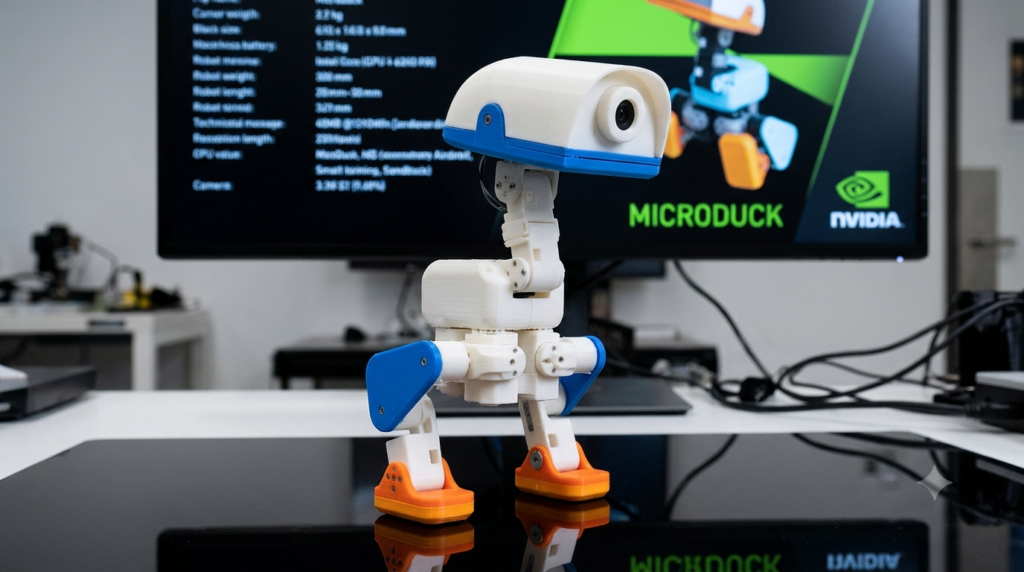
Microduck is a small, approximately 25-centimetre-tall, two-legged robot designed for experimentation, programming and robot-learning research. It is intended to be a platform people can work with — not merely a finished machine limited to a fixed list of factory behaviours.
Its ecosystem brings together two organisations:
- Hugging Face: the AI community and platform known for open models, datasets and machine-learning tools.
- Pollen Robotics: a French robotics company known for building accessible, human-interactive robots.
Microduck’s reported hardware features include:
- 15 motors to control its legs, neck and head.
- A front camera for visual observations.
- A depth sensor to estimate distances.
- Inertial measurement units (IMUs) to sense orientation and motion.
- An articulated beak that can act as a small gripper.
- Optional snap-on wheels for alternative movement.
The robot weighs roughly 800 grams, comes in four colours, and is priced at $399. Its software stack is open source under the Apache 2.0 licence, meaning developers can inspect, modify and extend it freely.
The key distinction is that Microduck is not simply a robot playing a pre-recorded animation. It is a platform on which developers can train, modify and deploy learned behaviours. The exact capabilities depend on the hardware, model, training and software stack used.
2. From traditional robotics to robot learning
First generation: robots follow instructions. Traditionally, engineers programmed robot movements explicitly. To make a robot walk, they could specify joint angles, motor speeds, balance rules and movement trajectories: move one leg, shift weight, lift the other leg, step forward and repeat. This can work extremely well in controlled environments. Industrial arms, for example, can repeatedly weld the same location with great precision.
The difficulty is unexpected conditions. A floor may be slippery, an obstacle may appear, or the robot may lose balance. A manually programmed system needs engineers to anticipate these situations and add logic for each one.
Second generation: robots learn behaviours. Machine learning offers another approach. Instead of specifying every movement, developers define a task and a learning process. The robot experiences different situations, receives feedback and adjusts its behaviour. Reinforcement learning is one important method for doing this.
Third generation: robot foundation models. The next direction is inspired partly by large language models. Rather than train a separate system for every tiny task, researchers seek models that learn reusable capabilities from diverse data: robot movements, demonstrations, images, instructions and simulated experiences. The goal is to make robots more adaptable, although general-purpose physical intelligence remains an active research area.
3. What did Jensen Huang demonstrate?
At NVIDIA’s GTC Berlin keynote on 21 October 2026, Huang showcased four Microduck robots. They demonstrated behaviours including walking, sitting, standing, lying down, and performing somersaults, responding to both scripted commands and spoken instructions. The technical story behind the performance was a development pipeline connecting AI agents, simulation, training and physical robot hardware.
The workflow involved technologies such as:
- NVIDIA Isaac Sim
- NVIDIA Isaac Lab
- Newton physics engine
- GPU computing and parallel simulation
- AI agents that assisted with environment creation and development
- Physical Microduck hardware
The demonstration matters because it shows how a robot behaviour can be developed and trained in a virtual environment before being evaluated on real hardware.
4. Simulation: the virtual laboratory
A digital twin is a computer-based representation of a real object or system. A simulated Microduck can include its body structure, joints, motors represented mathematically, physical properties and sensors. It can move in a virtual environment where actions have simulated physical consequences.
Developers can create thousands of virtual copies and let them practise simultaneously. One may fall, another may take a successful step, and another may learn that leaning too far forward causes a fall. The computer can run many experiments in parallel — far faster and cheaper than repeatedly repairing and resetting physical robots.
Simulation is not a perfect copy of reality, but it makes large-scale experimentation practical. NVIDIA Isaac Sim and Isaac Lab are designed to support this kind of robotics development.
5. The technology stack behind Microduck
NVIDIA Isaac Sim — the virtual world. Isaac Sim is a robotics simulation environment. Developers can build rooms, floors, ramps and obstacles; import robot models; simulate cameras and depth sensors; and observe movement, collisions and falls. It supplies the simulated world in which the robot practises.
NVIDIA Isaac Lab — the learning environment. Isaac Lab is a framework for training robot behaviours, including reinforcement-learning and imitation-learning workflows. A useful analogy is: Isaac Sim is the playground, Isaac Lab is the training programme, and the robot policy is the behaviour being learned. Isaac Lab can run many simulated environments in parallel.
Newton — the physics engine. Newton is an open-source physics engine in the NVIDIA robotics ecosystem. It helps simulate physical interactions: foot-ground contact, friction, gravity, collisions and how movement changes when a robot loses balance. Without physics, a virtual robot would be an animation; with physics, actions have consequences.
RTX Spark and larger GPU systems. NVIDIA’s compact AI computing systems can support local development, model execution and evaluation. They should not be confused with the hardware used for every training computation. In the showcased obstacle-course workflow, large-scale reinforcement-learning training used an NVIDIA RTX PRO 6000 Blackwell Workstation Edition GPU with 4,096 parallel simulated environments. Local systems and cloud or larger GPU infrastructure can serve different parts of the workflow.
AI agents — development assistants. AI agents can assist with understanding a task, planning a project, researching robot capabilities, preparing assets, constructing a simulation and supporting evaluation. In the demonstration, agents helped create a simulated obstacle course. Isaac Lab then trained the robot’s locomotion and perception policy. This is a combination of AI-assisted engineering and machine-learning training — not one AI magically inventing an entire robot.
6. How exactly is Microduck trained?
Consider the goal: teach Microduck to walk over an obstacle without falling. Training involves several connected steps:
- Define the task: Specify what success means — move forward, maintain balance, avoid obstacles and reach a destination.
- Build the simulated body: Represent body links, joints, actuators, physical properties and sensors so the simulation responds realistically.
- Define observations: Give the policy information such as camera observations, joint positions, orientation and motion state.
- Define actions: Allow the policy to issue control commands that adjust movement, posture or direction.
- Design rewards: Provide feedback for progress and success, and penalties or reduced rewards for falls, collisions or lack of progress.
- Practise in simulation: The policy acts, the simulator calculates consequences, and the learning algorithm updates the policy.
- Scale experience: Many parallel environments generate training experience simultaneously; their experiences can contribute to a shared policy.
- Evaluate and deploy: Test the trained policy, export it in a suitable format and evaluate on physical hardware.
The reward examples above are illustrative; they are not the exact reward coefficients used in NVIDIA’s experiment. A reward function expresses what behaviour the training process should encourage.
7. Reinforcement learning, explained simply
Reinforcement learning (RL) is a machine-learning approach in which an agent learns to make decisions by interacting with an environment and receiving feedback. Think of teaching a child to ride a bicycle: the child tries, tilts, falls, adjusts and tries again. The learning mechanism is mathematical in a robot, but the basic idea of improving through experience is similar.
The five important components are:
- Agent: the robot’s learned policy.
- Environment: the simulated world.
- Observation: camera and robot-state information.
- Action: motor-control commands.
- Reward: feedback about progress or failure.
The loop is: observe → decide → act → receive feedback → improve → repeat.
The objective is to find a policy that performs well over time, not merely to memorise one successful sequence.
8. How does a robot learn to walk?
Walking is a coordinated control problem involving balance, gravity, body movement, foot placement, joint movement, ground contact, timing and momentum. A robot must continually adjust movement to avoid falling. Humans coordinate their torso, arms, legs and balance together; robots also need coordinated control.
Whole-body control is one approach to coordinating movement and balance. In some architectures, a higher-level policy decides what the robot should do while a lower-level controller helps execute movement reliably. This separates task-level decisions from the mechanics of stable motion.
In short: “What should the robot do?” is different from “How should its joints move to do it safely?” Modern robotics systems often separate these layers.
9. Sim-to-real transfer: moving from virtual to physical
A policy learned in simulation must eventually work on a real robot. Simulations are never perfectly identical to reality: motors respond differently, surfaces have varying friction, sensors produce noise, batteries change voltage, and real movements have delays. A robot that walks perfectly in simulation may fall on physical hardware. This difference is called the sim-to-real gap.
How developers reduce the gap. One strategy is to improve the simulation’s accuracy. Another is domain randomization: vary conditions during training, such as surface friction, motor response, sensor noise, physical parameters and timing. The aim is to prevent a policy from depending on one perfect virtual condition and make it more robust.
NVIDIA’s Microduck workflow discusses actuator modelling and domain randomization. Hugging Face’s tutorial describes training in simulation and deploying it on a real Microduck. Physical testing is still essential; sim-to-real techniques do not guarantee success.
10. NVIDIA GR00T and its relationship to Microduck
Microduck is a physical robot platform. GR00T is NVIDIA’s robot AI development platform and model family. They are related to the same broader robotics ecosystem but are not the same thing.
NVIDIA introduced Project GR00T in March 2024 as a general-purpose foundation-model initiative for humanoid robots. The name stands for Generalist Robot 00 Technology. The objective is to develop models that can understand human instructions and perform a variety of physical tasks.
How GR00T learns. NVIDIA describes a combination of:
- Human videos
- Real robot demonstrations
- Simulated robot trajectories
- Synthetic training data
Human videos provide examples of people interacting with objects. Robot demonstrations ground behaviour in a machine’s physical capabilities. Synthetic data can add examples at scale. Combining these sources can help models generalise beyond one narrowly defined task, although human and robot bodies differ and translating video into motor commands is difficult.
GR00T N1.6, N1.7 and N2. NVIDIA’s GR00T N1.6 work combines higher-level robot policies with locomotion and whole-body control. Its training includes additional teleoperation data across robot platforms. At GTC 2026, NVIDIA announced GR00T N1.7 in early access, including generalised robot skills and dexterous control, and previewed GR00T N2, a next-generation model based on DreamZero research. These developments indicate a move from individual demos toward reusable robot-intelligence platforms.
11. AI agents helping train robots
Traditionally, robotics engineers had to design environments, create assets, configure robots and training, monitor learning, evaluate results, debug failures and repeat. AI agents can assist with parts of this workflow. Given a request such as “teach Microduck to walk through a room with ramps, boxes and obstacles”, an AI-assisted process might research the robot, plan the environment, prepare assets, assemble a simulation, configure training and help evaluate results.
Some steps can be automated; others require engineering supervision, validation and human decisions. The innovation is the integration of AI-assisted development with simulation and robot learning — not that robots independently invented their own training.
12. Why NVIDIA is interested in robots: the business story
NVIDIA is not primarily trying to manufacture every robot in the world. Its strategy is to provide computing infrastructure, simulation platforms, software, models and tools that other companies use to build intelligent machines. This resembles its position in AI computing: GPUs, CUDA and software libraries support a broad ecosystem of developers and companies.
NVIDIA’s robotics business model:
- Training GPUs: companies buy computing systems to train robot models.
- Cloud computing: robotics developers rent GPU infrastructure.
- On-robot computing: robots use NVIDIA computing modules.
- Software ecosystem: companies adopt NVIDIA development platforms.
- Simulation: businesses use digital environments to develop and validate robots.
- AI models: developers build products around pretrained robot models.
- Enterprise infrastructure: industrial companies deploy physical-AI systems.
NVIDIA provides technology across these layers, while robotics companies build the actual machines and applications. An open ecosystem can attract developers, encourage experimentation and increase demand for training and computing. This is a strategic opportunity, not a guarantee that every open robotics project will generate revenue for NVIDIA.
13. Why open-source robots matter
Microduck’s open approach makes it a platform for experimentation. One developer might train walking over uneven terrain, another recovery from falls, another grasping, and another a competition environment. People can share policies, code and experiments. A robot’s capabilities may increasingly depend not only on its manufacturer but also on its models, datasets, software ecosystem and developer community.
This is a meaningful shift: the manufacturer need not be the only organisation capable of improving a robot’s behaviour. Openness can accelerate learning, although hardware constraints, safety and quality control still matter.
14. How this technology could evolve
Robots learning from demonstrations. A person could demonstrate picking up a cup, placing an object on a shelf, opening a drawer or sorting items. The robot records the demonstration and a learning system uses it to adapt behaviour. Imitation learning and teleoperation-based training are already important research directions. The aim is to reduce the need to manually program every action.
More adaptable robots. A warehouse robot might eventually use a more general model to move a package, pick up a container, place an item on a shelf or navigate around an obstacle. General-purpose models are being developed toward this direction, but a model trained on one robot or environment does not automatically work elsewhere.
Learning from video. Human videos contain information about object interaction, movement and task sequences. Researchers are exploring how robots can learn from them. But human hands and robot grippers differ, as do human and robot bodies. Video does not directly specify the motor commands a robot should execute, so it is useful training material rather than a complete solution.
AI agents as robot task planners. A future robot might receive the instruction “prepare this room for a meeting”. An AI agent could break this into subtasks — identify chairs, move them, clear the table, arrange objects and verify completion — while a robot policy executes physical actions. The system would need to detect failures, verify results and handle unexpected situations.
Shared learning across robot deployments. Experiences from many robots could potentially be collected and used to improve shared models. Updated policies could then be trained, validated and deployed elsewhere. This feedback loop is promising, but it raises challenges around privacy, data quality, hardware variation, safety and governance.
15. Limitations: what the technology cannot yet promise
- Learning one skill is not learning everything. A robot that walks over a ramp has not automatically learned to cook, clean or operate machinery. Each task has distinct physical requirements.
- Simulation is not reality. Policies that perform well in simulation can fail on physical hardware. Real-world testing remains necessary.
- Robots do not automatically understand like humans. A robot can recognise objects and execute learned actions without possessing human-like understanding. Its capabilities depend on models, data, sensors and training.
- Dexterity remains difficult. Manipulating flexible objects, fragile items, tools and precise mechanisms remains challenging.
- Safety is a major concern. Robots near people must detect danger, avoid collisions, stop when necessary and operate within safety constraints. Training alone does not solve safety.
- General-purpose robotics is still developing. Impressive demonstrations and useful industrial tasks exist, but reliably handling the unpredictable complexity of everyday environments remains a major challenge.
A successful demonstration is not the same as a dependable commercial product. Reliability, cost, deployment speed, safety and consistent performance determine whether a robot can perform useful work at scale.
Why Microduck matters more than its size suggests
Microduck is small, and its movements are simple compared with a human. But the technology surrounding it illustrates several important developments: robotics is becoming more accessible; simulation is central to training; reinforcement learning can teach behaviours; foundation models are moving into physical environments; AI agents can assist robotics development; open-source communities can experiment with robot intelligence; and GPU computing is increasingly important in robotics.
These developments could collectively reshape how robots are designed, trained and deployed.
Conclusion: AI is moving into the physical world
The Microduck demonstration is not simply about four cute robots following Jensen Huang’s instructions. It is about a different approach to building intelligent machines. Instead of manually programming every movement, developers can create environments in which robots learn behaviours. Instead of testing every experiment on physical hardware, they can practise in simulation. Instead of developing every capability independently, researchers can build reusable models and learning systems. AI agents can also assist with planning, simulation construction and evaluation.
The larger vision is a world in which AI does not merely understand information or generate content — it can also learn how to interact with the physical world. That is what NVIDIA means by Physical AI, and Microduck is one approachable way to see that future taking shape.
Sources and further reading
- NVIDIA — Using AI Agents to Teach Robots Like Microduck to Walk in Simulation — Technical walkthrough of agents, Isaac Sim, Isaac Lab, parallel reinforcement learning and sim-to-real preparation.
- Hugging Face — Train in Simulation, Deploy on a Real Robot: Microduck with Isaac Lab 3.0 — Training, policy export, deployment and sim-to-real workflow.
- Microduck — Official robot information — Hardware specifications, sensors, learned behaviours, open-source stack and product information.
- NVIDIA — Isaac GR00T — Robot foundation models, VLA models, training and deployment.
- NVIDIA Research — GR00T N1 — Foundation-model research, training-data mixture and VLA approach.
- NVIDIA — Robotics ecosystem announcement, March 2026 — Industrial adoption, robotics partnerships and physical-AI deployment.
- NVIDIA GTC Berlin keynote — October 2026 — Event context and Microduck demonstration.
- Reuters — Jensen Huang and the robot ducks — Independent event coverage.
About the author: Kavinila is a software professional exploring AI, robotics and machine learning.
Disclaimer: Hardware specifications, pricing and product details are as reported at the time of writing and may change. This article is for educational purposes and is not affiliated with or endorsed by NVIDIA, Hugging Face or Pollen Robotics.